Sunday, 11 December 2011

Quantum of Problems

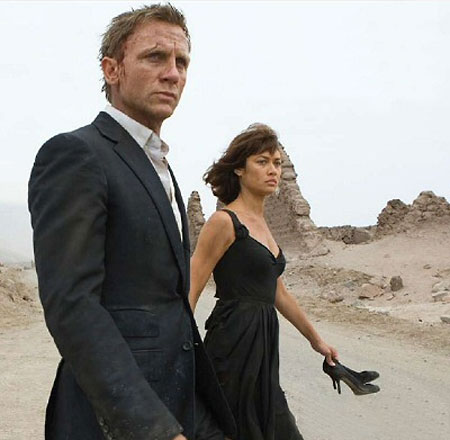
Garth Franklin wrote a few days ago, for Dark Horizons, on the problems with Quantum of Solace:
"Asked about scripts being an after-thought on huge productions, Craig responded "Yes and you swear that you’ll never get involved with shit like that, and it happens. On “Quantum”, we were fu**ed. We had the bare bones of a script and then there was a writers’ strike and there was nothing we could do. We couldn’t employ a writer to finish it. I say to myself, “Never again”, but who knows? There was me trying to rewrite scenes – and a writer I am not.’"

I have watched Quantum of Solace a few times and my analysis of the film is already written up - in detail.

Suffice to say, I have never been too frustrated with the script. Don't get me wrong, I appreciate the difficulties the film had and I completely understand the frustrations Daniel Craig and Marc Forster may have had with writing the script on set. But it wasn't the script that was the primary problem - it was the editing. It felt like it was spliced together with no knowledge of what was on the screen. In fact, only after a few watches do I understand what is going on. I knew something was "off" during the opening car chase ... and when it says "[car chase]" in the script, then it is clear that aspect of the script which was not going to change in the slightest. The buck stops firmly and squarely on Forsters head - and no amount of "writers-strike" talk will change that. 

Large Association of Movie Blogs

Thursday, 8 December 2011

Rocky V (John G. Avildsen, 1990)

"Natures smarter than people think"

Introduction

This film was clearly supposed to be the end of the Rocky film series. Stallone was initially keen to continue the story in Russia and continue the dichotomy between Drago and Rocky, but for no clear reason, this idea was scrapped. Instead, the film - like all the films - continues where the previous film left off starting a whole new drama. Rocky has returned from Russia - he is shaking, his memory is fading. As the press ask him questions on his return, a passionate businessman proprositions him in the middle of the junket setting him up for a future fight. Rocky turns it down...

Getting Back To His Roots

It is clear that now Rocky has effectively conquered the world, the next step is to take him back to his roots. He has to lose everything: his health, his money and, towards the last act, he nearly loses his family. Though we have briefly revisited Philadelphia in the previous two films, it is Rocky V whereby he goes back to Philadelphia for the duration. Unlike Rocky and Rocky II, this is not where he wants to be - and crucially not where he wants Adrian to be. These historical facets to Rocky V are only possible because of what we know about. It is fair to say that Rocky V can be watched without any prior knowledge - but the deeper connection to Philadelphia, the passing of Mickey and the poverty that Rocky has worked his way out from ensure that this film is a much more fascinating film, given the past we have seen.

The Birth of a Champion

I think that all the previous films build Rocky up from a point in his life whereby he could've easily sat back and let the world pass him by. There was a history before the first film, whereby Rocky was a street-fighter and trained to be a champion under Mickey, but settled to be a 'bum' collecting money for a "two-bit gangster". The first film sets him up as he is given a chance to reclaim what should be his - and the rest is history. If Rocky V was made today, I wouldn't be suprised if it would be a prequel: Rocky Begins, Rocky Origins or Rocky: The Beginning. The film constantly relates to his past - the training Mickey gave him, his own Son facing the challenges in school and understanding that sometimes, "fighting is neccessary" (despite disliking violence), the training of Tommy Gun and - most importantly - his whole 'birth' in street-fighting.

The Boxing Business

Connecting to the 'roots' of Rocky is additionally his detachment from the boxing 'industry'. Rocky always had Mickey as his agent and trainer. Rocky tells Tommy Gun:

"This is what Mick told me about. About the business, the dirty part of the business. These managers, when they represent these fighters, they promise them the world, then they, they suck' em dry, leave them, leave them in the gutter, broke Tommy"


This is a fascinating development of the franchise. The whole idea of Rocky as a product has been explored before, but the importance of money versus the necessity of money. We know that Rocky had it all and, through greed of his accountant, he lost it all. Rocky trains Tommy Gunn up from his roots, taking him way back to his own beginnings in an incredible scene directly lifted from the first scene in Rocky, whereby Rocky took on Spider-Rico, now Tommy is fighting. It is easy to think that Rocky is desperate to relive his own past glories - and to some extent he is - but by breaking Tommy down to the same place Rocky came from, we can see how what Tommy doesn't have is the same heart. As cliche as that may be, it comes back to the belief in oneself - a respectable, honourable and dignified belief. Only through seeing these relevant connections to his past do we appreciate how, even before he started his training to fight Apollo Creed, Rocky was respected, honourable and dignified. These traits are what made him who he is. 

Upper Class to Working Class

In parrallel to Rocky's story, we also have Stallone's son playing Rocky Jnr. Rather than coping with the change from poverty to wealth, and back to poverty again - Rocky Jnr has moved from wealth to poverty. Through no fault of his own, his entire attitude has to change - he is the new 'posh' boy in an alien school. Rocky tries to encourage him, but it is a long road ahead for Rocky Jnr. His understanding of fighting changes as, initially, he is reluctant to get involved, but he eventually understands that some people will only respect you through your own self-defence. Is this a comment on fighting itself - or the neccessity of this trait within urban poverty. I think this film surely shows how skilled Stallone is in writing a drama whereby the three characters constantly weave in and out of each others storylines, with tensions between all three: Rocky and Rocky Jnr establishing a relationship, the envy Rocky Jnr feels towards Tommy Gunn, Tommy Gunn's respect for Rocky - whilst fully exploiting Rocky's need for a fighter-son. A fascinating trichotomy (I looked it up, it's a word for "man having a three-fold nature").

Incomplete Finale

With so many strong parts of the story, it is a real shame that the end seems to fall a little flat. Rather that finishing in the ring, with Rocky taking on Tommy Gunn ... he fights in the streets of Philly. Everyone chants and cheers around the two, with one-liners thrown around flippantly - "Yo, Tommy! I didn't hear no bell..." - whilst the fight becomes much more physical, as Stallone rugby-tackles Tommy and the two use whatever items they find lying around to hit each other. It's poetic that, at this stage in the franchise what was the final fight, was going to be on the streets marking the territory that Rocky hails from. But it is also not the finale we are expecting to see - the lights, the ropes, the back-to-back punches and strategies employed - and commentated on - as the fights often went to 15-rounds. Where are the huge bombastic displays? I completely understand the reason why - considering how epic the fight in Russia was, it makes complete sense to go as small-scale as possible. In fact, how much smaller-scale could it get? Rocky beating his son up in the bedroom?

In 1990, this very much felt like the end - but I wouldn't be suprised if after multiple viewings of the film, Stallone knew the finale should be in the ring. But it took a long time to make it happen. It seems that Mickey was right: "Natures smarter than people think"
Large Association of Movie Blogs

Tuesday, 6 December 2011

Food and Films - Is This The Future?

Mark Lawson, for The Guardian, discusses a slight-change in cinema viewings at a shopping centre:
"However, a new initiative at the Odeon atop the Whiteley's shopping centre in west London tantalises cineastes with the possibility one day of an evening's movie-going that is both Oscar-nominated and Michelin-starred. Chef Rowley Leigh, from nearby Le Cafe Anglais, is introducing a range of superior at-seat meals including a fillet-steak burger and red mullet risotto. Ordered on arrival, these will be served by waiters "during the trailers", which, given the picture houses' current recession-led desperation to advertise everything arriving in the next year, would allow time for a five-course banquet in many venues."
Read the full article: http://www.guardian.co.uk/lifeandstyle/shortcuts/2011/dec/05/cinema-restaurant-rowley-leigh

The idea of huge meals in the cinema, initially, sounds ridiculous. Loud, monstrous-munching of a burger and crunching of salad accompanying the soundtrack of cinema. No way.

But then look - consider the 'delivery' of the food during the trailers ... consider the regular 20-minute length (maybe more...) of the adverts and trailers before the film. You'd be finished before the opening credits. Or at least all the big-munching and crunching would be finsished - at the start of the actual film, you would merely be picking at the left-over chips or small vegetables that are sat on the side.

The idea of utilising the ever-growing trailer-time might be a great change to a cinema night out.

Then again ... what about the smell ... 

Large Association of Movie Blogs

Sunday, 4 December 2011

A-Z #105: Jaws

You can pick up hundreds of DVDs for a round-pound each - it doesn't matter. It's never about quantity, it's about quality. A-Z is my way of going through my collection, from A-Z, and understanding why I own the films ... or you can tell me why I should sell 'em


#105 - Jaws

Why did I buy it?

At the time I bought it way back in 2000, I could not remember the time I had watched it. I knew it was an important film, but I could not vividly recall the details of the film. By purchasing it, I could rewatch it and refresh my memory.

Why do I still own it?

Obviously, since I bought the film, I have watched it many times. I have even watched the film at my school with some of the kids during a Film Club. They enjoyed it, but not half as much as I expected. I have a feeling that the slow-tension that builds throughout the film was a little bit too slow for the kids. I only hope they appreciate the idea of the shark swimming underneath their feet when they are swimming about on their summer holidays. A must to own, and I have a feeling it is a must on Blu-Ray when it arrives ... the stunning
Large Association of Movie Blogs

Thursday, 1 December 2011

Rocky IV (Sylvester Stallone, 1985)

"...he's going to have to kill me. And to kill me, he's gonna have to have the heart to stand in front of me. And to do that, he's got to be willing to die himself. I don't know if he's ready to do that."

Introduction

I was told prior to watching Rocky IV that the final few minutes are "way ahead of it's time". This is not only a sports film, but it has global issues representing the Cold War and the idea of idealism and arrogance in America. Stallone dipped his toe into controversial territory in Rocky III, whereby he hinted at themes of racism and equality. Attitudes towards poverty and fighting to get out of oppression. But nothing is explicit. Clubber Lang had no affiliations with the Black Panthers or any organisation. He had no clear political ties - for all intents and purposes, Clubber Lang was simply doing it "for himself". I wrote about how the allegiance of Apollo Creed ensured a clear analogy, but ultimately it was not so explicit that it could become controversial. Rocky IV presents us with Drago - he is directly representing Russia and the support of the Government in the final match assures us of the poiltical message we are expected to see. Drago is brought to America to fight amongst the Heavyweight Professional Boxers - and this is important to Russia, as it shows their acceptance in world sports events. But it is clear they are trying to prove a point ...

USA vs Technology

Before discussing the clear themes of the Cold War, it is also worth highlighting the use of technology in the film. The strangest moment, possibly in the entire franchise, is the introduction of Paulie's robot. Inexplicably, Paulie is expecting a present from Rocky and Adrian - hopefully a car - but instead, it is a Robot. Reluctant at first, Paulie comes to depend on it - even changing the voice from masculine to feminine. Technology itself is a theme throughout the film as Rocky trains in a traditional manner - his jogging, push-ups, weight-lifting, etc. Drago trains using specialised equipment that specifically targets his muscles - we learn that he punches with exceptional force through a computer screen.

The idea of depending on technology to enhance performance, with regard to Drago, or to decrease performance (by completing jobs so you don't have to), with regard to Paulie is explicitly shown. But the film ultimately highlights how these forms of technology can only assist so much. The belief-in-oneself and passion to win cannot be generated by technology - and it is this passion and belief that will secure success. When we see a montage between Rocky and Drago training for their own fights - it is Rocky who is using exceptionally dated modes of training (picking up logs, holding up carts, jogging through snow, etc) whilst Drago relies on tehcnology to support him. I guess the outcome at the end of the film explains which is the stronger traning mechanism.

While we discuss the montages, Bill Conti was not hired to create a score for this film and so we do not have a 'Gonna Fly Now' sequence. Instead we have four (!!!) sequences, all very eighties and all very electronic - composed this time by Vince DiCola. I would love an adapted version of this film whereby Conti's themes were integrated, replacing "Hearts on Fire" because this one choice alone is what, for me, forces me to dislike this film. It simply doesn't feel like Rocky without Conti's score. Even the score when Rocky wins the fight at the end starts exactly like Conti's finale of "Going the Distance" before going a completely different direction with the melody. I would like to confirm that Bill Conti was back on board for Rocky V and Rocky Balboa. Thank God.

USA vs Russia
There are so many ideas littered throughout this film, so I shall simply try and go through them one-by-one. An interesting line at the press-conferance is the respect Russia has for Apollo - Russia's team explain how they are very happy to fight Apollo as he is respected so much at home. Clubber Lang mocked Apollo, noting how he was a "has-been" and the conversations between Rocky and Apollo clearly indicate how much Apollo wants to prove something. Apollo seeks respect, but he is blinded by arrogance - this small reveal that Apollo is already respected but still craves more, shows his weakness.

The fight in America between Apollo and Drago is gratutious and verges on complete mockery. James Brown singing "Living in America!", girls in leotards, dancing, whilst Apollo comes down from above, wearing his stars and stripes. You think about Apollo pre-fight against Rocky and multiply that ten-fold. The expectation is Apollo will win, but this set-up clearly shows it won't pan out. America's culture is of success and excess - the show is pure excess. This is a complete contrast to Rocky fighting Drago, whereby Russia are patriotic but there is nothing in comparison to the pre-fight show in Vegas.When Apollo dies, it is very quick before the story moves on - Rocky holding Apollo, cut to Apollo's funeral. A missed opportunity - imagine a sequence as Apollo is rushed out of the ring on a stretcher, gasping for his last breath. Maybe even some final lines. Instead, we have the excessive show and a quick-fight before we watch his funeral.

The idea that they are 'sports stars not soldiers' is ambiguous at this point - like soldiers, Drago has killed Apollo. The Cold War is very much about a war fought behind closed doors, the invisible enemy - the death of Apollo shows a defeat that, though clearly murder, is not counted as such as it was within the ring.

Then we have the final speech from Rocky, following his defeat of Drago in Russia:
"During this fight, I've seen a lot of changing, in the way you feel about me, and in the way I feel about you. In here, there were two guys killing each other, but I guess that's better than twenty million. I guess what I'm trying to say, is that if I can change, and you can change, everybody can change!"
The very idea of breaking down a huge conflict across nations through change is a big theme to tackle - Rocky even acknowledging the countless deaths caused by war. The overt political themes and statement at the end, understandably, may be going a little too far for Rocky but it is a progression from the themes in Rocky III. If we see Rocky as an example of fighting your personal demons of success, Rocky II fighting the difficulties and conflicts in a relationship - balancing what each person wants in a relationship whilst respecting each other in equal measure. Rocky III is bigger as the film tackles conflict within American society, Rocky IV is tackling worldwide themes of war and conflict across countries - even the poster imitates the iconic image of the flags at Iwo Jima with the use of the flag, the multiple-levelling of people with a diagonal centre-point.

Humanising the Enemy

But Drago also serves to draw a parrallel to Rocky himself. We only saw Apollo Creed's wife very briefly in Rocky II and Rocky III, but she was never integral to the plot. Clubber Lang had nobody unlike Drago who, like Rocky, has Ludmilla (Bridget Nielsen). This woman supports him and what he stands for. She supports him and, during the press conferance in Russia, you can see how strong her love is for him. Both Rocky and Drago have the support of their country and their spouses - and we are left to consider what Rocky has to defeat him.

The answer? Being human. Belief is what is core. Technology and Patriotism is important, of course, but it is not what makes a winner. Only through Rocky's perseverance does Drago begin to doubt. Drago has no reason to lose - he has everything going for him. But he doesn't have the same belief - Rocky's self-belief ensures he fits the model of 'Idealistic American' and it is this that defeats Drago - Drago thinks Rocky is "iron" and Rocky personally realises that Drago is not a machine (a form of technology). He is human.

Ahead of its Time

I would not neccessarily state that Rocky IV is ahead of its time - global issues and social difficulties are often presented as allegory in cinema. But, it is also not merely Good vs Bad. Rocky represents the individual man fighting against the boss. Rocky represents the human who worries about the technological age the future is presenting them. Rocky represents America and the way it could tackle conflict. Rocky could not go further - he has tackled worldwide issues and he won't go to space. So he has to go back. To Philadelphia. To Mighty Micks. Cue Rocky V.
Large Association of Movie Blogs