Showing posts with label Brad Pitt. Show all posts

Monday, 13 January 2014

Twelve Years A Slave (Steve McQueen, 2014)

Why is Twelve Years a Slave relevant now? It may follow on the heels of slavery-themed Django Unchained and Lincoln but there is much more to Steve McQueen’s epic and accomplished film. This tale of slavery is bookended as Solomon Northup (Chiwetel Ejiofor) is a free man before and after, his twelve years in captivity.

Lingering, prolonged shots force you to acknowledge the true horror of the period. This is how animalistic and selfish humans can be. Tip-toes in mud squeeze and squelch as they keep a hanging man alive. Sadistic plantation owners and carpenters abuse and show their true intentions as they fear the African-American who has risen above them in dignity and strength. Solomon refuses to be broken. He demands a woman cease her crying as she mourns the loss of her children. This strength is a lack of humility and as an audience we remain conflicted. “I survive!” he tells her when justified his lack of emotion towards his own loss of family.
Twelve Years a Slave is one of the most important films of the 21st Century, not least as it horrifically highlights the history of a society that too often prides itself on Christian values. Edwin Epps (Michael Fassbender) uses these values to control his slaves, reading scripture to support his exploitation. Epps himself, akin to Ralph Fiennes ‘Goeth’ in Schindler’s List, is a torn man. He lusts after, and is conflicted, about his feelings towards the innocent Patsey (a radiant Lupita Nyong'o). Using Christian values to control, dominate and hurt others is not unlike the use of Islamic text to terrorise others. In both cases, it is an abuse of doctrine to achieve a selfish, personal goal. McQueen demands your attention with poetic and poignant themes.

Why is Twelve Years a Slave relevant? Solomon struggles to write down his experience. He crudely cuts into a violin the names of his family – could he forget their names after years in captivity as “Platt”? One of the few sequences repeated is a moment, midway through his twelve years, whereby he tries to write down his experiences – and initially fails. Solomon, without realising, is one of the very few who can actually articulate his plight. The vast majority of slaves were illiterate – and, we are told, if they were literate they would be foolish to tell others. A fair comparison to slavery in the US is the holocaust - an atrocity that happened less than a century after the abolition of slavery. Records are unclear as to how many died in slavery. Seven million Jews died in concentration camps while the Atlantic slave trade is responsible for at least nine million deaths – but sources claim it could be as high as fifty-five million. At one point, as a free man, Solomon sees a slave who follows him in awe, but Solomon doesn’t act, content in his own safety. Told in flashback, Solomon doesn’t understand his inactivity. As Solomon needed to document his twelve years – McQueen needed to make this film. We need to watch it and we need to talk about it.
 
A review is an analysis of the film at hand, but this is the legacy of Twelve Years a Slave. This is a document to support and remind us of what humans are capable of – and what they can be content with. Why is Twelve Years a Slave relevant? Because it could happen again. Art can be reflection; art can be informative; art can be a reminder – or warning – to what is possible. Chitewol Ejiofor, in his final moments on screen, at one point looks out to camera. His gaze meanders, considerate and thoughtful; the camera doesn’t move. After viewing over two hours of cruelty, this moment is calming and his look travels through the lens. Channelled through Ejiofor’s defiant performance, Solomon looks at us. This is one written testament that could be adapted. How many stories exist that are not written? Voiceless victims that cannot be heard? Solomon is a voice that we can hear but too many silent stories exist.
 
Published and written originally for TQS Magazine on 13th January 2014

Thursday, 7 March 2013

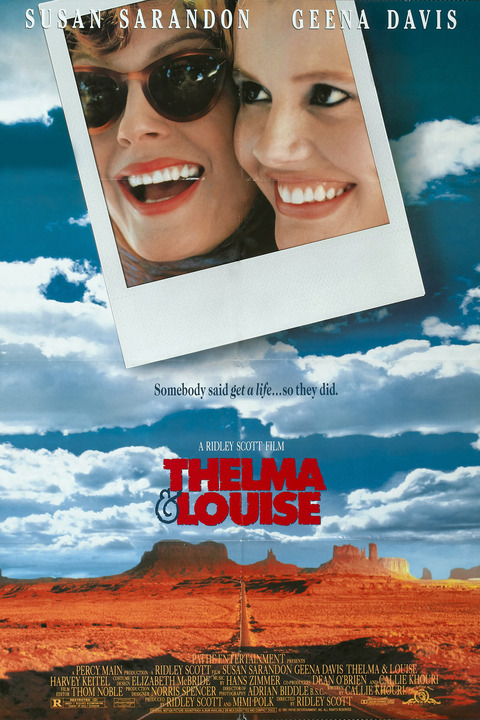
Thelma & Louise (Ridley Scott, 1991)


"I don't ever remember feeling this awake." 


Introduction

This was my achilles heel. The conversation would begin whereby the group sing the praises of Ridley Scott. I love Alien. I love Blade Runner. I love Gladiator. I love Black Hawk Down. Then, some smart-alec claims how they love Thelma & Louise. I would sit in silence. I haven't seen that one. Until now.

As a man, this film seems to stand up and shout: "If you are a man and you act like a man ... then you can fu** off". In all it's angry intonations, this is what I believe is at the core of Thelma & Louise. Anyone who thinks otherwise is kidding themselves. Women are beautiful creatures - as stunning as the landscapes our titular characters drive past. Men pass down the highways, oblivious to the beauty, and instead simply dominate the roads with their hulking bodies, shaped like trucks. From the outset, it is clear that there is more beneath the surface of Thelma & Louise; Louise (Susan Sarandon) has clearly been through something exceptionally heart-breaking; the abuse which Thelma (Geena Davies) has faced for years in a loveless marriage doesn't bear thinking about. With regard to Thelma, it is no surprise she is naive to the intentions of men as she has needed to block out the horrendous treatment from her husband for years.

Rape

Sexist attitudes can often emerge within (what people believe) is a grey-area when discussing rape. Released in 1991, the conversation regarding who is at "fault" was much more prevalent. The opening-act set-up shows Thelma dancing "cheek-to-cheek" with Harlan (Timothy Carhart) and, as he propositions her, her rejection transforms him from a seedy, lecherous man into a rapist. Or, more honestly, he was always a rapist. No transformation - no discussion. Harlan is a rapist. End of.

In the same argument, you can play with "Who is responsible for the theft of the money". Thelma's attraction to JD (Brad Pitt) lead to the wired money being stolen. Was Thelma foolish for falling for JD in the first place? Shouldn't she have thought ahead before opening her door to a stranger - however attractive he is? And, as I understand, Brad Pitt in Thelma & Louise is the definition of an attractive-male.

The truth is that just as Harlan is a rapist, JD is a thief. Thelma isn't responsible in either case - the men are. Too often, people will transfer the blame, but it is clear that in both cases, men are at fault. Indeed, when you then reflect on the sequence involving sexist men stating how "women love that shit", you realise men seem to be given a pass on such attitudes. Even now, 22 years on, has it stopped? It should stop - and like Louise, we should be angry about it.

Ridley Scott-isms

But this is by no means 'alien' (badum-tish!) to Ridley Scott's style of film-making. A stunning shot passing across the '66 Thunderbird seems to hark straight back to Alien, whilst the transition from a sunny-road to a rainy urban-street to reveal Jimmy returning home doesn't seem a far stretch from the type of pan-shots in Blade Runner. Indeed, the fact that Ridley supported the change-in-gender of the lead-character of Alien also supports his pro-feminism attitudes.

But the film remains an established classic due to the brutally honest attitude towards sexism. Louise, who is clearly intelligent and incredibly aware of the inequality within society is also tragically cynical - and carries her own cross to bear from a time in Texas. Thelma seems naive - but is, more likely, keen to keep a positive spin on life and refuses to be dogged-down by the ills of society. Men, on the other hand, are shown as desperate for power - primarily power over women, but additionally over each other.

The question that hovers over the film is the finale as Thelma and Louise, rather than give themselves up, decide to drive off the stunning cliff-faces of Arkansas. Are we to believe that there is no way out of our sexist, animalistic ways? Can we ever exist in an equal society, whereby women and men are seen as the same? Or are we destined to pass the blame of our own gender-issues onto each other ...

Originally published/written for Man, I Love Films on 7 March 2013

Saturday, 14 May 2011

A-Z #78: Fight Club

You can pick up hundreds of DVDs for a round-pound each - it doesn't matter. It's never about quantity, it's about quality. A-Z is my way of going through my collection, from A-Z, and understanding why I own the films ... or you can tell me why I should sell 'em


#78 - Fight Club

Why did I buy it?

I was friends, when younger, with a guy called Mark. He was into football and was quite the ladies man. Ultimately, we didn't stay friends for very long but, considering how proud he seemed to be of his masculinity, it is ironic how he also introduced me to Fight Club and Snatch. Both very much about men and about being a Man. With a capital M.

Why do I still own it?

Mark owned the films himself so after watching the film once, I then hunted down the DVD - and ensured I got that sweet paper-like sleeve. David Fincher, when you watch this film, you realise is a masterful director. His incredibly savvy use of special effects and stylised shooting in this film completely contrasts to his reserved and non-stylised direction in The Social Network. You can see that he understood the zeitgeist - following the capitalism of the 80's, now people became obsessed with products ... to the point that products and items became to define people. Today, it still stands and the film hasn't dated as the older-PC's simply look retro in the grubby, dirty world that Fincher has created. Incredible filmmaking and, I believe, the most important Fincher film.
Large Association of Movie Blogs