Monday, 25 March 2013

Sightseers (Ben Wheatley, 2012)


"He's not a person, he's a Daily Mail reader!"


When I watched Ben Wheatley's second feature-film Kill List, I couldn't help but recall Shane Meadows Dead Man's Shoes. Both films centered around assassin-like killers who lived within poverty-stricken areas while both films technically shot (primarily) hand-held and were rooted in Brit-realism. Whereas following Dead Man's Shoes, Meadows continued to explore Brit-realism and drama in early 80's-set This is England, it seems Ben Wheatley has veered into comedy territory with Sightseers. With Edgar Wright producing, Wheatley utilises the writing and acting talents of Garth Marenghi's Darkplace and The Mighty Boosh regulars Alice Lowe and Steve Oram respectively. Wheatley has moved into a completely different direction that surely shows his flexibility and diverse skill-set. That's not to say that Kill List and Sightseers have nothing in common, but considering Wheatley wrote and directed episodes of a comedy-series The Wrong Door and even directed a documentary on Steve Coogan, it may be that Ben Wheatley is more Edgar Wright than he is Shane Meadows.

Sightseers

Set in the North of England, we join Chris (Oram) and Tina (Lowe) as they travel from the city-scape of Redditch and onwards into Yorkshire, passing by quirky caravan stop-offs and pencil museums. Chris and Tina are 'those' people who seem to thoroughly enjoy caravanning and visiting obscure tourist attractions. Head to toe in cajoules and walking-boots, Chris and Tina, we feel like we know - but something isn't exactly 'right' about them. A small confrontation with a litterer soon ends in tragedy - with, initially, an ambiguity over whether it was purposeful or not. In either case Chris and Tina are a little too comfortable with the death of a fellow man.

A comparison made by Ben Walters in Sight & Sound, is Mike Leigh's Nuts in May. Mike Leigh's kitchen-sink drama's do seem to be a clear connection to Sightseers - especially within the middle-aged, middle-class couples our travellers meet. The other comparison, interestingly, would be Bonnie & Clyde, as we are regularly told about the "search" for the murderers on the local radio-station our culprits listen to.

The Wrong Tarantino Film

Co-writer and actor Steve Oram compares murder in Sightseers to murder in a Hollywood film; "Tarantino does it and it's really cool - and then we come along and we're wearing cajoules and being Brummies". He explains how it is "an American idea, but done in an English way". This is Sightseers strongest asset as this thoroughly 'English' depiction of the beauty and character of the UK country is something we rarely see across the cinema-screen - indeed, the last time I recall such beauty was the landscape shots that appear in the Scotland-based, final-act of Skyfall.

This country-village sentiment goes a long way when reflecting on British comedies too - especially Edgar Wright's output in Shaun of the Dead and Hot Fuzz. Hot Fuzz particularly has a stronger connection to Sightseers than Wheatley maybe lets on. The countryside peace; the strange characters in villages; the murder and death - and sudden-moments of gore. The difference is the realism Wheatley feeds into the story - and the subtext regarding social-classes (Chris has been made redundant while Tina is a carer for her insulting and argumentative Mother). Does Wheatley believe that the constant change in economic status within communities in Britain will explode? Akin to Falling Down - something will have to snap.


It is this underlying tension that is truly terrifying. The moments of gore are all played for shock - and they are often followed by strange mannerisms and statements by our lead couple cushioning the blow. The use of a hammer in Kill List seems to linger with you throughout the film - and remains an unexpected, deeply shocking moment. Sightseers doesn't hold such horror - but it does get under your skin in a different way. Surely, people are angry; and it is only a matter of time before their anger and outsider status becomes a purpose for reaction. Tina and Chris' reaction is clearly excessive - but the frustration they feel is something that the current climate knows all too-well.

Originally written/published on Flickering Myth on 23 March 2013

Large Association of Movie Blogs

Saturday, 23 March 2013

Jack The Giant Slayer (Bryan Singer, 2013)

"Fee-Fi-Fo-Fum"

As we step ever-nearer to X-Men: Days of Future Past, we need to establish where Bryan Singer is. His previous feature-film Valkyrie received mixed reviews, while Superman Returns ended the franchise completely - giving way to this years Man of Steel. In that regard, it has been a neat ten years since he has directed a film that has been championed by fans - X2. Indeed, X-Men, unto itself, opened the door to the multi-billion dollar industry of "Comic Book Movies" - and, specifically, the "darker" comic book films. Prior to X-Men, Comic-book films were little more than strange, quirky films for nerds - but now, because of Bryan Singer, they are so much more. The question lingers awkwardly over Jack the Giant Slayer: Does Singer work his magic and reinvent the fairy-tale genre?

Jack and the Beanstalk

We know the story: Jack sells his cow for beans, he plants the beans and it turns into a beanstalk. Jack climbs the beanstalk to find a giant. Jack The Giant Slayer combines the popular fairytale with the "older and darker" Jack the Giant Killer. Jack the Giant Slayer is released following the success of previous fairytale instalments Snow White and the Huntsman and Tim Burton's Alice in Wonderland - both Jack and the latter film released in 3D. This fairytale trend seems to capitalise on a known property (we all know the story...) and, I assume, the parents who seek to take their children  to watch a story they may have told to them before bed.

This particular version includes an opening that involves a monk riding a horse and Warwick Davies amongst a group of actors re-enacting the story of Giants. Our hero, Jack (Nicholas Hoult) joins a group of Knights - dubbed "The Guardians" - including Ewan McGregor and Eddie Marsan (a far cry from the brutal roles he has played in Tyrannosaur and This is England '86) to save a damsel in distress, Princess Isabelle (Eleanor Tomlinson), from the world of Giants that Jack unwittingly creates a link between. It emerges (in the opening moments of the film) that these Giants were banished to the world above by humans after we took hold of a crown - created by the heart of Giants - that controls them. In Gantua, the Giants have been angry and stewed for hundreds of years ... ready to re-emerge when the opportunity arises. With Jack's help, it does - and Royal figures are ready to take advantage of this opportunity as controlling Giants means that they could control earth itself.

Imagination

But it is an unwieldy story that struggles to comfortably make the jump from book to screen. I could even argue that the beauty of these stories is within the childhood wonder you have when first hearing them; you imagine the world and beasts that are described. The simple story of Jack and the Beanstalk is equally clear in its moral tale - as it is in the ambiguity of the fantasy-locations. What do the giants look like? Some children imagine them as tall as skyscrapers - some may imagine them as merely tall people. The beanstalk - is it slimy and slippery like the vines that creep out of a lake? or are they dry and dusty? Singer decides to define these details in a mixed hot-pot of styles and fashions. Characters wear hats from the 1920's and Jack dons a leather jacket ... but, of course, the medieval Lord of the Rings action sequences hark back to the Middle-Ages.

Because of this eclectic mix, the film simply doesn't ring true and, though children may thoroughly enjoy the amalgamation of time-periods and fashions, as an adult it has a strange unbalanced tone. Tim Burton, despite his narrative inconsistencies, always seems to balance the tone - creating Gothic worlds that naturally and organically connect to each other; Bryan Singer's town of Cloister and land of Gantua fail to convince. Technically, he nods towards Jurassic Park as plodding footsteps are heard in a lush rainforest as it rains heavily - and akin to the T-Rex in The Lost World, we inevitably see a limp body stuck to the base of a scaly foot as a Giant tramples on a human. Even the half-Gollum, half-"Ed" (the crazy Hyena from The Lion King) additional head on Giant (Bill-Nighy-voiced) Fallon goes against the horrific character deaths - silly characters and gore-filled deaths - younger children may dislike the gore; older children may dislike the silliness.

For the Kids

Despite these uneven elements, assuming the gore isn't taken to heart, younger children will like the film. Fantasy, simplicity in story-telling, an epic finale and quirky characters. Children, for better of worse, love a good fart-joke and they love a gooey, slimey bogey pulled from a giants nose - so an adult-criticism seems void when the audience this film is made for will clearly enjoy it. It's not as profound as a Pixar film, and it lacks the modernism of a Marvel superhero film - but it is a tale children understand. Bryan Singer has not created a masterpiece and nor has he reinvented the genre - he has simply made a film that exploits all the trends that, in fairness, children seem to be interested in. Singer hasn't dropped the ball on this; he just lacks passion. Little more than a footnote in a biography, Jack the Giant Slayer is merely a manufactured children's film that will be forgotten within a year. In the hands of Bryan Singer, it is an acceptable children's film - but he needs to be more selective when he chooses projects in future.

Written/Originally published for Flickering Myth on 21 March 2013

Large Association of Movie Blogs

Thursday, 7 March 2013

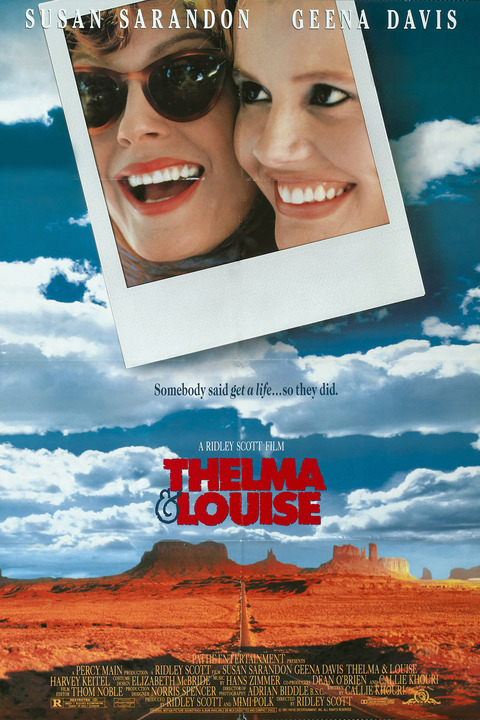
Thelma & Louise (Ridley Scott, 1991)


"I don't ever remember feeling this awake." 


Introduction

This was my achilles heel. The conversation would begin whereby the group sing the praises of Ridley Scott. I love Alien. I love Blade Runner. I love Gladiator. I love Black Hawk Down. Then, some smart-alec claims how they love Thelma & Louise. I would sit in silence. I haven't seen that one. Until now.

As a man, this film seems to stand up and shout: "If you are a man and you act like a man ... then you can fu** off". In all it's angry intonations, this is what I believe is at the core of Thelma & Louise. Anyone who thinks otherwise is kidding themselves. Women are beautiful creatures - as stunning as the landscapes our titular characters drive past. Men pass down the highways, oblivious to the beauty, and instead simply dominate the roads with their hulking bodies, shaped like trucks. From the outset, it is clear that there is more beneath the surface of Thelma & Louise; Louise (Susan Sarandon) has clearly been through something exceptionally heart-breaking; the abuse which Thelma (Geena Davies) has faced for years in a loveless marriage doesn't bear thinking about. With regard to Thelma, it is no surprise she is naive to the intentions of men as she has needed to block out the horrendous treatment from her husband for years.

Rape

Sexist attitudes can often emerge within (what people believe) is a grey-area when discussing rape. Released in 1991, the conversation regarding who is at "fault" was much more prevalent. The opening-act set-up shows Thelma dancing "cheek-to-cheek" with Harlan (Timothy Carhart) and, as he propositions her, her rejection transforms him from a seedy, lecherous man into a rapist. Or, more honestly, he was always a rapist. No transformation - no discussion. Harlan is a rapist. End of.

In the same argument, you can play with "Who is responsible for the theft of the money". Thelma's attraction to JD (Brad Pitt) lead to the wired money being stolen. Was Thelma foolish for falling for JD in the first place? Shouldn't she have thought ahead before opening her door to a stranger - however attractive he is? And, as I understand, Brad Pitt in Thelma & Louise is the definition of an attractive-male.

The truth is that just as Harlan is a rapist, JD is a thief. Thelma isn't responsible in either case - the men are. Too often, people will transfer the blame, but it is clear that in both cases, men are at fault. Indeed, when you then reflect on the sequence involving sexist men stating how "women love that shit", you realise men seem to be given a pass on such attitudes. Even now, 22 years on, has it stopped? It should stop - and like Louise, we should be angry about it.

Ridley Scott-isms

But this is by no means 'alien' (badum-tish!) to Ridley Scott's style of film-making. A stunning shot passing across the '66 Thunderbird seems to hark straight back to Alien, whilst the transition from a sunny-road to a rainy urban-street to reveal Jimmy returning home doesn't seem a far stretch from the type of pan-shots in Blade Runner. Indeed, the fact that Ridley supported the change-in-gender of the lead-character of Alien also supports his pro-feminism attitudes.

But the film remains an established classic due to the brutally honest attitude towards sexism. Louise, who is clearly intelligent and incredibly aware of the inequality within society is also tragically cynical - and carries her own cross to bear from a time in Texas. Thelma seems naive - but is, more likely, keen to keep a positive spin on life and refuses to be dogged-down by the ills of society. Men, on the other hand, are shown as desperate for power - primarily power over women, but additionally over each other.

The question that hovers over the film is the finale as Thelma and Louise, rather than give themselves up, decide to drive off the stunning cliff-faces of Arkansas. Are we to believe that there is no way out of our sexist, animalistic ways? Can we ever exist in an equal society, whereby women and men are seen as the same? Or are we destined to pass the blame of our own gender-issues onto each other ...

Originally published/written for Man, I Love Films on 7 March 2013

Tuesday, 5 March 2013

Cul-de-sac (Roman Polanski, 1966)


Roman Polanski remains a fascinating filmmaker to this day. Alongside Andrej Wajda and Jerzy Skolimowski, Polanski came to the fore in the late 1950’s in Poland. The BFI in London are screening all of Polanski’s films during January and February 2013 and through January, essays on separate films will be released on Flickering Myth in the hope that you too can join us in reflecting on Polanski’s diverse and ever-expanding career. Film essays will include Knife in the Water, Cul-de-sac, Repulsion, Chinatown and The Tenant.

Introduction

Knife in the Water set the standard for Polanski. For his directorial debut, it was nominated for Foreign Picture at the Oscars, losing out to Fellini’s 8 ½. If you lose out to a film considered one of the greatest of all-time, you can go home proud. Suffice to say, Polanski was sought after, eventually turning to England to create Repulsion and Cul-de-sac. A troubled production – Donald Pleasance turned up in a Lincoln to the blustery, small village, whilst Francoise Dorleac joined production with a small dog named Jarderane. Hardly small-scale, it remained true to Polanski's roots - claustrophobic; a small three-way cast; use of deep-focus, etc. "Cul-de-sac was decidedly a Roman Polanski film. Its obsessional tone, its fascination with the mechanics of power and humiliation" (Polanski: The Filmmaker as Voyeur by Barbara Learning) On set, Polanski became demanding and brutal – not least because he had clearly based the film on his relationship with Basia Kwiatkowska, which ended four years prior. Though associated with many hallmarks of his films - this film particularly had a deeply personal edge.

The Castle on a Hill

The story is set-up as two criminals are fleeing the scene of a crime. Akin to Reservoir Dogs, we don’t see or know about the heist or robbery – but for whatever reason, they wind up on Lindisfarne. Albie (Jack MacGowran) has been shot, and can barely move; Richard (Lionel Stander) has been shot in his arm, so he seeks help and finds recently-married couple George (Donald Pleasance) and Teresa (Francoise Dorleac), who live within an old castle on the island. Teresa is unfaithful – our first sighting of her is topless with a neighbour’s son; George is weak and clearly cannot control his considerably younger wife – who we assume has married him for money.

In a direct parallel with The Ghost (titled The Ghost Writer on its US release), the family are isolated; cut off from the outside world as the phone line is disconnected. The marshy landscape and surrounding water combined with an upper-class elitism of the married couple, again connect with the Pierce Brosnan/Ewan McGregor thriller.

Power Games

Unlike The Ghost, though both films have an interest in the role of a powerful female, Cul-de-sac has a clear comedic edge – mocking the childish weakness of Donald Pleasance against the “Lan-dan gangster” of Lionel Stander, who carries a certain Alan-Sugar-like charm.

The sexual-politics are established early on – from the reveal of Teresa’s infidelities through to the awkward manner that George is introduced, standing as a child carrying a kite. In this opening sequence, we witness the dynamic through the eyes of Richard – or ‘Dickie’ as he comes to be known - as he checks out the building before making his intentions known; again, Polanski places us in the place of the voyeur. But it seems ‘Dickie’ is not seduced by Teresa either – Dickie represents the stronger, dominant male opposed to George who, through the humiliating requests Teresa asks of him, is reduced to a bumbling outcast. Teresa almost becomes an accomplice to Dickie as she assists in digging the grave of Albie after he dies from his wounds – and consequently mocks George, laughing and drinking with Dickie. Hardly an example of the supportive wife. In a similar manner to Repulsion, though a key female-role, Teresa is never supported in her frustration of George. Though we laugh at his fear, her lack of support and ridicule of him ensures that she is never seen in a positive light either.

Why, come on in!

If the tone is unclear from the outset, when a family unexpectedly visits the castle, the humour is suddenly heightened. From the married-man who is flirting outrageously with Teresa through to a change in role as Dickie, to remain in the castle until his “boss” finds him, takes on the ‘Gardener/Butler’ job to keep up appearances. Guns are fired; stained-glass windows are broken. Though tense, we all stifle a chuckle when George fails to even hang his own picture back on the wall after a brief discussion of his artistry.

When researching Knife in the Water, it was clear that his exploration into social-issues was a rare theme he tackled in his debut, but I do believe that Cul-de-sac manages to touch upon some basic assumptions between the elitist, ignorant upper-class against the rough, hyper-masculine working class. Dickie manages to mock George tremendously to Teresa’s amusement and, only in the final moments does George manage to re-affirm himself and protect his wife. Of course, it’s too late then, and the guilt, shame and anger at his own initial inaction combined with the self-destructing nature of his flawed attempt at protection (destroying the only way of escape; giving Dickie an opportunity to use the tommy-gun) leads to only further upset. Knife in the Water ended somewhat ambiguously as characters continued their life with no clear change – whilst Cul-de-sac finishes as George, akin to Gollum in The Hobbit, perches atop of the rock, crying out about his own fate. He has lost the love he adored - not through the actions of others – but through his own inaction.

You need only look to the end of Chinatown to see a striking parallel – as Nicholson looks to his love, and sadness overwhelms him. They have lost their love – and they blame themselves. Though Nicholson's 'Gettes' is not alone, George is - and as the credits role on the top of George's misery it would be wrong to let him wallow in his own sadness. We want to comfort him a little and tell him: Forget it George, its Lindisfarne.

Originally written for/published on Flickering Myth on 15 January 2013


Large Association of Movie Blogs

Friday, 22 February 2013

Superman Returns (Bryan Singer, 2006)

"He's a little fragile, but he's gonna grow up to be big and strong... just like his dad."

Introduction

Considering Superman Returns halted any further sequels to the original vision of the Superman series, it is a fair assumption that reviews were negative and mixed at best. Strangely, it continues to hold on to a 76% score on Rotten Tomatoes, only just earning a 'fresh' rating almost seven years after the films release. Despite the positive reviews, the film controversially "failed" at the box-office. In no uncertain terms, though raking in almost $400m (becoming the ninth highest-grossing worldwide film of the year), the total expenditure is rumoured to be as high as $263m alongside a marketing budget at $100m. A little mathematics clearly show a small-return for Hollywood - and in comparison to the highest-grossing worldwide film-release of 2006, Dead Man's Chest, it is an upsetting comparison, as the sequel to Pirates of the Caribbean earned a little over $1bn worldwide, on a budget of $225m. Now that's a success.


Callbacks

The failure of Superman Returns, Bryan Singer believes, is because the film was "nostalgic and romantic". His personal love for Richard Donner's original overshadowed a clear story and structure whereby the religious allegory he attempted to include seemed like a token-gesture at best - rather than a core-element to the film.

After five years, Superman (Brandon Routh) returns to planet Earth after an absence of five years. Lex Luthor (Kevin Spacey) has managed to get himself out of prison and has re-visited the Fortress of Solitude to steal a shard of Kryptonite. Superman, as Clark Kent, returns to the Daily Planet to find that Lois Lane (Kate Bosworth) is now married to Richard White (James Marsden), with child, and she has achieved her dream by winning a Pulitzer Prize for an article titled: "Why the world doesn't need Superman". The assumption is that the film takes place post-Superman II so continuity dictates that this is why Luthor knows where the Fortress of Solitude is and why Superman's father is still Marlon Brando.

The Kent homestead remains the same and, cinematically, the titles and music clearly tell us that this is the same universe. Singer, after trying so hard to connect the film to Donner's original duo, then ignores crucial elements. In one throwaway line, Lois Lane mentions to Superman information about her "colleague" Clark Kent - and Superman responds that he doesn't know who he is. Wasn't Kent the connection between Lois and Superman in the first few films? Even Luthor doesn't seem aware that his "land" strategy for wealth is similar to his plan of breaking off a section of California in Superman: The Movie.

Ryan McNeil wrote how "the biggest problem with the film is how it doesn't know whether it is a sequel of a reboot" - and I completely agree. The world we are watching, we need to invest in - and a lack of clarity in the universe will always be difficult to follow. I would assume that those who will appreciate the film most will be those who haven't seen the 1978 and 1980 originals - but then they will feel at a disadvantage when Marlon Brando appears and it is clear "something" happened before. Singer needed to either (a) set it post Superman IV: The Quest for Peace or (b) simply reboot the whole thing. Instead he tried to get the best of both worlds - and failed.

Religious Allegory

Upon viewing the Man of Steel trailers, like all the Superman films, the Jesus-parallel always manages to become a theme. The original four films seem to blend the Jesus narrative that is inherent within the Superman story with an anti-consumerist, anti-capitalist message within a pro-America (quite the oxymoron!) context. Superman Returns wisely side-steps the capitalist argument (in 2006, we were all enjoying crazy-wealth and only those in Wall Street knew what was due to hit...) and focuses our attention on the struggles Superman personally has. Has the world moved away from the notion of a divine being? Can we paraphrase Lois Lane's article to read "Why the World doesn't need a Saviour/God/Religion"? The state of America post 9/11 inevitably shook many people to reflect on their faith - and whether a God could exist in such dark times.

The religious themes don't stop there. Bryan Singer himself, when explaining the "too-heavy" nature of the film said:
"I've always felt that the origin of Superman is the story of Moses -- the child sent on a ship to fulfill a destiny," said Singer, a producer on the upcoming X-Men: First Class. "And this was a story about Christ -- it's all about sacrifice: The world, I hear their cries. So what happens? He gets the knife in the side and later he falls to the earth in the shape of a crucifix. It was kind of nailing you on the head, but I enjoyed that, because I've always found the myth of Christ compelling and moving. So I hoped to do my own take, which is heavy s--- for a summer movie."
The Observer critic Philip French concurs, writing:
"Superman comes back to earth at a time of great crisis and is virtually crucified by Luthor, using shards of the deadly green Kryptonite crystals as nails. While he lies dying in hospital, his mother, Martha, is among the grieving crowd, while inside the sick room his son looks reverently at the Superman outfit lying on a chair as if it were the prophet's raiment, the martyr's shroud or the hero's armour. Something resembling a resurrection follows, accompanied by heavenly music"
The strongest moments are the sequences that prove this Messianic role Superman plays in society. The scenes when he flies into space and we "hear their cries". The world praying and seeking help - and the pressure Superman has as the only person who can make a change. From the footage of Man of Steel, the assumption is that the upcoming Zack Snyder film will tackle the dichotomy between Superman as an outsider, due to be "crucified" by those who deny his awesome power and Superman as a God, due to save the earth whether we agree with his methods or not. Fear against trust. It seems that the most profound sentiment, and the theme that resonates best, is the Christ story in the modern-era. Not the set-up-a-franchise "Superboy" thread ...

Like Father like Son

Almost as a deleted narrative, that refused to lay on the cutting-room floor, it is worth considering the 'Son of Superman' story. Isolation and loneliness is a key element to the film as Superman left earth to explore Krypton - only to return alone. He pines after Lois Lane, but she has moved on - leaving him on his own. His experiences and moments of reflection emphasize how his challenges and difficulties are unique to him - and something no one else understands.

In that regard, the idea of resolving this by presenting us with a Son of Superman doesn't feel too awkward. But it feels obvious. The set-up of Lois Lane bringing up a child, who is roughly the same age as Superman's visit to Krypton, seems a little too purposeful - and personal - destroying the "twist" that Superman has a Son at all. The relationship between Clark Kent and Jason also toys with his Father-like role to his son, and society - but it simply seems show-horned in. This is in addition to the relationship Lane has with Richard (Son-of-Perry) White - a strong, capable and loving Father to the Son Superman never had. Do we root for Superman to "win" Lois back? Do we see Richard White as a bad Father? On both counts, no. So is there any tension in this love-triangle? Again, no.

The Fall

As characters, multiple facets are weak, but it is worth considering the symbolic nature of the roles. The inevitable 9/11 reference will surely creep into a 2006 'event' movie release, with a deeply American character-story such as Superman Returns. And especially as Metropolis is, for all intents and purposes, New York City. Using the Father-Son thread as a starting point - and reminding ourselves of the [expensive]  use of Brando's footage to build further foundations between Son and Father, we can clearly feed this into a thought regarding the moment Superman falls to earth.

As Metropolis citizens look to the New York sky, they see Superman pierce the sky in a moment of shock and awe, before he falls to the ground creating a ground-zero in the middle of Central Park. What is surely a clear-connection, it is iconic God-like role-model and iconic God-like buildings hitting the ground and, from the dust, they rise up again. Superman, and the "American Way", is the foundation - and the Father - to the country. Americans and those in a post-9/11 world are the children to the American Way - but for a brief moment, the fall of the twin towers changed America and changed what it stands for. But, those foundations remain, and as Superman whispers to his son, they will be passed on and America will rise up from the dusty ground to be strong once again.

To weave in so many themes and ideas, it is inevitable that the film is too long. Despite the many, many themes buried deep into the story, the final act seems to continue from one action-beat to the next. Lex Luthor's destruction leads to Lois Lane nearly dying ... leading to Superman nearly dying ... leading to his regeneration ... leading to his comeback. And so it goes on. In a cinematic-sense, the "father" to this film was Richard Donner's Superman, but his was a flawed film and - though successful - had many problems that has consequently bled into Bryan Singer's "fragile" homage to the original. This should have re-started the Superman story but it did not, and Chris Nolan's Batman Begins showed us all how it "should be done". Such a template, seven years later, is crucially the reference point for Zack Snyder and his Man of Steel. And I cannot wait.

Large Association of Movie Blogs